
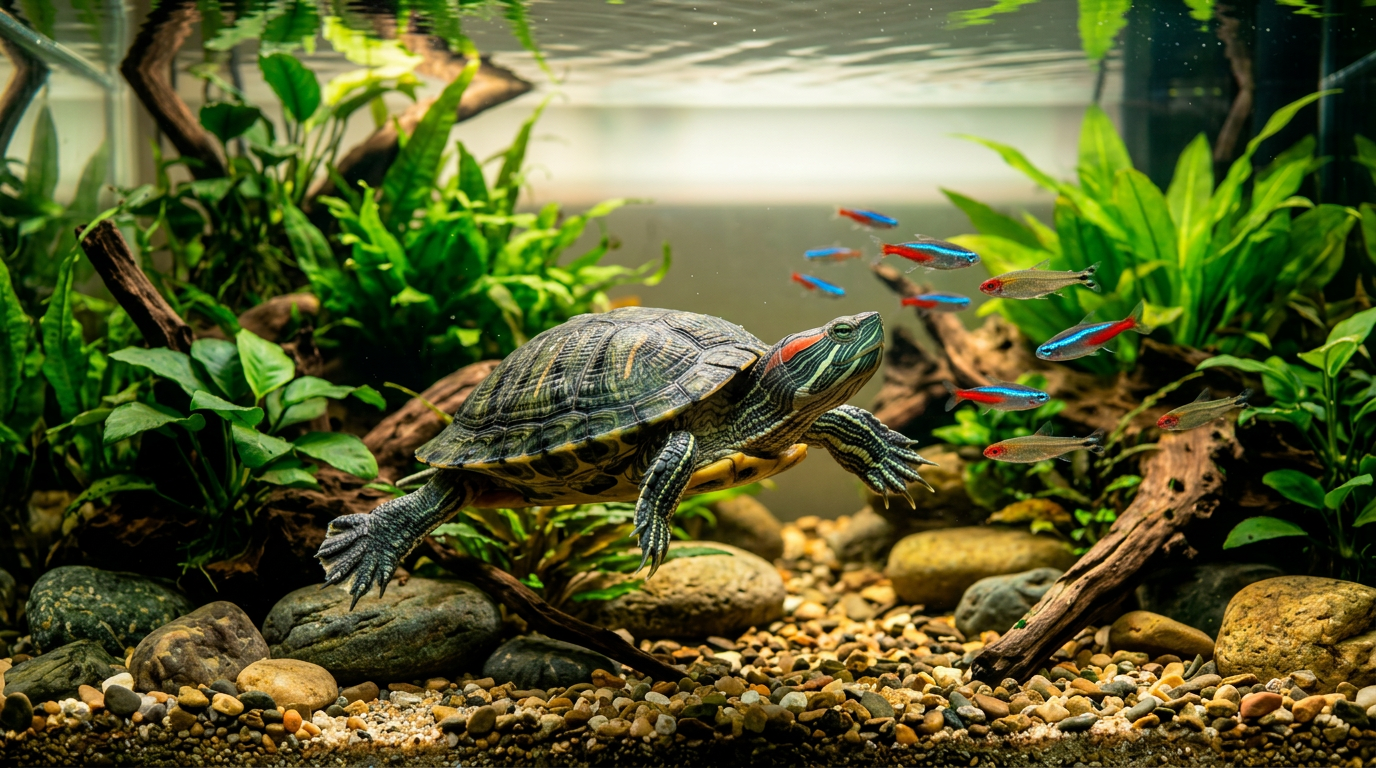
Not all fish can live with turtles. In fact most of them cannot. If you have ever searched what fish can live with turtles and gotten a simple list with no context, that list probably cost someone a lot of fish. The real answer depends on your turtle species, your tank size, your setup, and honestly a little bit of luck.
Here is the full picture — no shortcuts.
Why This Is Harder Than It Looks
The first thing I had to accept is that turtles are not community tank animals by nature. They are opportunistic feeders, which basically means if something fits in their mouth and moves, there is a good chance they are going to try to eat it. That applies to smaller fish especially. The smaller the fish, the more likely it is to end up as an unplanned snack rather than a tank mate.
The type of turtles you are working with also matters enormously. A red-eared slider behaves very differently from musk turtles, softshell turtles, or a diamondback terrapin.
Some species are more aggressive hunters, some are more laid back, and some, like the alligator snapper, really should not be paired with fish at all because their hunting instinct is just too strong.
Box turtles are primarily land animals and are not really suited for a deep water setup with fish in the first place, so they fall outside this conversation almost entirely.
Juvenile turtles and baby turtles tend to be more carnivorous than adult turtles, meaning they are going to be more aggressive about going after fish when they are young. As turtles get older and larger, many of them shift toward a more plant-heavy diet.
This makes adult turtles slightly easier to pair with fish than younger ones. That is not a rule you can count on completely, but it is a pattern worth knowing.
Turtle Species Compatibility: Does Your Turtle Even Work With Fish?
Before picking fish, you need to be honest about your turtle.
Not every species is a realistic candidate for a mixed tank — and starting with the wrong turtle makes everything else irrelevant. Here is a quick breakdown of the most common species and how they tend to behave around fish.
Red-eared slider — the most commonly kept turtle in the US and a moderate challenge when it comes to fish. They are curious, active, and opportunistic feeders. Fish can work with sliders but the setup needs to be right — large tank, fast fish, plenty of hiding spots.
Musk turtle — one of the better options for a mixed tank. They are small, less aggressive than larger species, and their compact size means they simply cannot eat bigger fish. If you are building a mixed tank from scratch, musk turtles give you a genuine head start.
Painted turtle — similar temperament to the red-eared slider. Active and opportunistic. The same rules apply — fast fish, large space, good hiding cover.
Map turtle — relatively manageable compared to more aggressive species. They tend to be less relentless hunters than sliders and can work reasonably well with the right fish in a well-set-up tank.
Softshell turtle — one of the most aggressive hunters on this list. They are fast, they are stealthy, and they are built to ambush prey. Pairing softshell turtles with fish is genuinely difficult and not recommended for most setups.
Alligator snapping turtle — do not attempt this. Their hunting instinct is too strong and too effective. Any fish added to an alligator snapper tank is essentially a live feeding, not a tank mate.
Box turtle — not really relevant here. Box turtles are primarily land animals and are not suited to a deep water setup with fish. They fall outside this conversation entirely.
The bottom line is simple. Start with a species that gives you a fighting chance — and if you already have an aggressive hunter, be honest with yourself about whether this combination is realistic for your situation.
So what fish can live with turtles?
Now for the part everyone wants to know. Which fish actually have a realistic chance of surviving in an aquatic turtle tank?
The best candidates tend to share a few traits. They are fast-moving fish, they are not so small that they get eaten immediately, and they are hardy enough to handle fluctuating water conditions. Let me go through the ones I have seen work most consistently.
1. Zebra danios
Zebra danios are one of the first fish I would point anyone toward. They are fast, they are small but not tiny, they are incredibly hardy, and they tend to move in large groups which makes it harder for a turtle to single one out.
They are not going to win every encounter with a determined turtle, but they hold their own better than most small fish.
2. Rosy barbs and Bala Sharks
Rosy barbs and tiger barbs are both worth considering, though tiger barbs come with the caveat that they can be aggressive fish toward other tank inhabitants. In a turtle tank that aggression matters less because the turtle is already the dominant presence, but it is worth knowing.
Rosy barbs tend to be a bit more easygoing and still move fast enough to avoid becoming an easy meal.
3. Rosy Red Minnows
Rosy red minnows are another option that comes up a lot in turtle keeping communities. Some people use them as feeder fish intentionally, but when kept in large groups in a larger tank they can actually hold their own for a decent stretch of time.
They are not going to last forever, but they are cheap, hardy, and add movement to the tank.
4. Koi / Large Goldfish
Koi fish and large goldfish come up as options for outdoor turtle ponds or very large indoor setups. The logic is that larger fish are simply too big to be eaten easily, especially by smaller turtles.
A full-grown koi in a large pond alongside a turtle has a reasonable chance of coexisting because the size difference makes predation impractical. In a standard indoor fish tank this is less applicable because the space constraints change the dynamic entirely.
5. Chinese algae eaters
Chinese algae eaters and siamese algae eaters are interesting options because they spend most of their time at the bottom of the tank scraping algae off surfaces, which keeps them out of the open water where turtles tend to hunt.
They serve a practical purpose for keeping the tank clean and their behavior pattern naturally reduces conflict. They are not foolproof, but they are a smarter choice than a slow-moving decorative fish with nowhere to hide.
6. Bala sharks
Bala sharks are a larger fish option that some experienced keepers have had success with. They are fast, they get big enough to be less tempting, and they tend to hold their ground rather than panic when a turtle comes near.
The downside is they need a very large tank to thrive properly, so this option only makes sense if your setup is already substantial.
7. Blood parrot cichlids
Blood parrot cichlids and convict cichlids are sometimes suggested as fish that can coexist with turtles because of their size and relatively tough personalities. A convict cichlid is not going to just sit there and get eaten without a fight, which sometimes causes a turtle to lose interest. That said, results vary widely with cichlids and a lot depends on the individual animals involved.
8. Fancy Guppies
Fancy guppies and feeder guppies are honestly not a great idea in most turtle setups. They are too small, too slow, and too easy to catch. If you add fancy guppies to a tank with a hungry turtle, you are likely going to watch them disappear pretty quickly.
9. Neon Tetras
Neon tetras fall into a similar category. They are beautiful fish and they do well in many community tanks, but in a turtle tank they are more or less feeder fish whether you intended that or not.

Fish to Avoid
Just as important as knowing what works is knowing what does not. Ghost shrimp and apple snails are often suggested as cleanup crew additions to turtle tanks. However, in my experience, they tend to become snacks fairly quickly. Turtles love hunting shrimp especially, so adding ghost shrimp is really just offering a live treat rather than establishing a tank mate.
Aggressive fish like the convict cichlid can sometimes cause problems in the other direction too. If a fish is aggressive enough to nip at a turtle, that creates stress for the turtle and can lead to injury on both sides. The goal is coexistence, not conflict, so finding a middle ground in temperament matters.
Setting Up the Tank for Success
Beyond choosing the right fish, the way you set up the tank makes a real difference in how well things go. Hiding places are essential. Rocks, driftwood, live plants, and decorations that create breaks in line of sight give fish places to retreat to when the turtle is active. A tank that is completely open with no structure gives fish nowhere to go and makes the turtle’s job of hunting much easier.
Tank size is everything. A cramped fish tank gives fish nowhere to go when a hungry turtle decides to chase them. The more space you have, the more territory there is to share, and the less likely the turtle is to constantly be in the same corner as the fish.
For a single adult red-eared slider, you are already looking at needing a large tank, somewhere in the range of a 75 to 100 gal tank as a starting point. If you want to add fish with any realistic chance of them surviving long term, you want to be thinking even bigger.
Feeding your turtle well and on a consistent schedule also helps. A turtle that is not hungry is less likely to aggressively chase fish. This does not eliminate the hunting instinct entirely, but it reduces the urgency.
Offering plenty of turtle food before the turtle has a chance to go after tank mates is one of the simplest behavioral management tools available, keeping fish in large groups also improves survival rates.
Water quality is one of the things that complicates the fish and turtle combination more than people expect. Turtles are messy. They eat, they produce waste, and they tear food apart in the water rather than swallowing it neatly. That creates a heavy biological load that requires strong filtration to manage. Clean water is non-negotiable for both the turtle and any fish sharing the space.
The body temperature of your turtle is also tied to water temperature, and that has to align with the needs of whatever tropical fish or aquarium fish you are thinking about adding. Most turtles do well in warm water in the range of 75 to 80 degrees Fahrenheit, which happens to overlap nicely with many tropical fish species.
You also need a proper basking area with UVB bulbs for your turtle, which affects the overall tank setup. The land area or basking platform takes up space and changes the layout of the tank, which is something to factor in when thinking about where fish can swim and hide.
There is safety in numbers, and a school of zebra danios moving together is a much harder target than a single fish sitting still. This applies to most of the schooling species, so if you are going to add fish, add enough of them to actually form a group.

What About Smaller Turtles?
Musk turtles and other smaller turtles are sometimes suggested as better candidates for fish cohabitation precisely because of their size.
A small turtle simply cannot eat a large fish, and many musk turtles are not as aggressive as larger species. This makes them one of the more manageable options if you are specifically trying to build a mixed tank from the start. Pairing musk turtles with larger fish or fast-moving mid-sized fish gives you a genuinely reasonable chance of things working out long term.
Smaller turtles still produce waste and still need proper filtration and water quality management, but the dynamic with fish is just naturally less predatory when the turtle is compact in size.
If you are newer to turtle keeping and want to try a mixed setup, starting with a species like musk turtles in a properly sized tank is a smarter entry point than going straight to a large red-eared slider.
Realistic Expectations
I want to be straight with you here because I think a lot of articles about this topic make it sound easier than it is. Keeping fish with turtles long term is genuinely difficult. Even when you do everything right, you are going to lose fish occasionally.
Turtles are unpredictable, and even a well-fed turtle with plenty of space will sometimes decide to go after a tank mate for no obvious reason. The fish that survives six months might not make it to twelve.
The best way to approach this is to go in with realistic expectations, choose the hardiest and fastest fish available, set the tank up to give fish every advantage possible, and accept that this is an ongoing management situation rather than a set it and forget it tank.
When it works, it looks incredible. A large tank with a thriving turtle and a school of active fish moving around it is genuinely one of the most impressive freshwater setups you can build. Getting there just takes patience, the right choices, and a willingness to learn as you go.
Frequently Asked Questions
Can goldfish live with turtles?
Large goldfish and koi in outdoor ponds or very large indoor setups can sometimes coexist with turtles simply because they grow too big to be eaten easily. Small fancy goldfish in a standard tank are a different story — they are slow, easy to catch, and unlikely to last long alongside a hungry turtle.
What fish can live with turtles?
The best options are fast, hardy fish that can hold their own in a turtle tank. Zebra danios, rosy barbs, bala sharks, and Chinese algae eaters all have a reasonable survival record. The key traits to look for are speed, size, and hardiness. Slow, small, or delicate fish rarely last long.
How big does a tank need to be for turtles and fish together?
For a single adult red-eared slider you are already looking at 75 to 100 gallons as a minimum. Adding fish means you want to go bigger — 125 gallons or more gives fish enough territory to establish their own zones and stay out of the turtle’s way consistently.
Do turtles eat all fish?
Not always — but they will try. Turtles are opportunistic feeders and anything that moves and fits in their mouth is a potential target. The goal is to choose fish that are fast enough, large enough, and savvy enough to avoid becoming a meal most of the time. No fish is completely safe but some have a much better chance than others.
What is the easiest turtle to keep with fish?
Musk turtles are generally considered the most manageable option for a mixed tank. Their small size limits what they can actually hunt successfully, and their temperament tends to be less aggressively predatory than larger species like red-eared sliders or softshell turtles.
Does feeding my turtle regularly help protect my fish?
Yes — to a point. A well-fed turtle is less motivated to hunt aggressively. Feeding your turtle consistently before it has a chance to go after fish reduces the urgency of the hunting behavior. It does not eliminate the instinct entirely but it is one of the most practical management tools available.
Final Thoughts
Looking back at that first tank where I lost half my fish in two days, I wish I had known even half of what I know now. The combination of turtles and fish is absolutely possible and can be genuinely rewarding, but it requires understanding what you are working with on both sides.
Choose the right fish species, give them enough space and hiding places, keep the water clean, feed your turtle consistently, and start with a turtle species that gives you a reasonable shot. Do those things and you will be in a much better position than I was when I started.
This blog talked about what fish can live with turtles. You might also enjoy: